TMO History
The Age of Richard Nixon – a study in cultural power
What do you think of when you think of Richard Nixon? Watergate, Vietnam, the televised debates with John .F. Kennedy? or perhaps you imagine the sweating, nervous, paranoiac portrayed by Antony Hopkins in Oliver Stone’s biopic Nixon? Images that emphasise his failures, that suggest a man unfit to be President, a villain and one thus [...]
Terrorism in Dostoevsky and Conrad – a Response from Irish History
The romantic view of terrorists as misfits and lost souls, presented by Dostoevsky and Conrad in their work, is very much at odds with the practical and structured guerilla warfare that was seen during Ireland’s War of Independence
Images, piety and women in late medieval devotion: The Hunt Crucifixion with Saint Clare.
First published in the journal of the University of Limerick History Society, History Studies, vol.6 (2005), pp.2-17. The small fourteenth-century Florentine panel in the Hunt Museum, Limerick, shows an image of the Crucifixion. Beside the cross the Virgin falls in a swoon, supported by one of the holy women and St John the Evangelist. At [...]
Who’s to blame? The Fosse Ardeatine and the struggle over memory in modern Italy.
One of the most infamous attacks against civilians, during the brief and bloody end-phase of the second world war in Italy, took place on March 24th 1944. The victims of the Fosse Ardeatine massacre were three-hundred-and-thirty-five Italian men, a fact recognised by all. Less clear, at least in popular memory, have been those ultimately responsible [...]
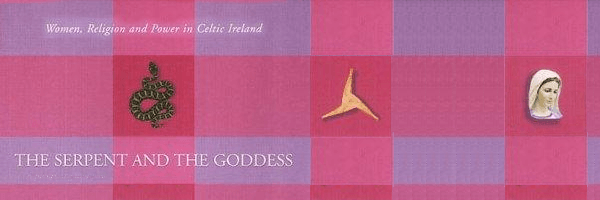
Sexuality, Sin, and Sacrifice – Deconstructing the Patriarchy. An interview with Dr. Mary Condren
Censorship is not limited to totalitarian States. It can be a subtle thing, when disconcerting ideas are not banned, but, through various means, marginalised. Dr. Mary Condren’s groundbreaking work The Serpent and the Goddess, a study on women, religion and power in Celtic Ireland, was never placed on an index of banned books, and yet [...]
Football and Fascism – The creation of Italy’s Serie A
On the 2nd of August this year (2005), football fans from the Sicilian city of Messina blockaded the strategic ferry route between the city and the Italian peninsula, protesting against their club’s relegation to Serie B. Another small episode in a long history of impassioned football support, and political intrigue (the Sicilian club were re-admitted [...]
Cosa Nostra – rebranding the Mafia.
“The mafia, in the strict sense of Cosa Nostra, the hierarchical criminal organization based in Sicily, does not ‘run Italy’ as you sometimes hear people rather glibly say,” explains John Dickie, senior lecturer in Italian at the University of London, and author of Cosa Nostra – a history of the Sicilian Mafia. It’s in response [...]
From Fertility Symbol to Political Propaganda – Decoding the Massa Marittima Mural.
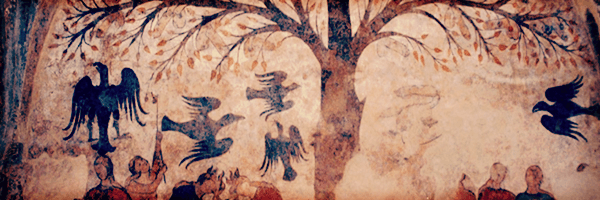
In the year 2000, during restoration work, a rare and important mural was uncovered at the communal fountain of the Tuscan town of Massa Marittima. It was not necessarily a welcome surprise, at least at first, as this painting from the Middle Ages depicted a tree covered with phalluses. “At first when the painting was [...]
Mapping the past – the Historian’s dilemma.
Historians take from the past only what suits their purposes. Of the last 2500 years of historiography the above statement probably holds true for most of the period and for most of the historians. It can be argued that it is the historian’s job to take from the past what suits their purpose. The Historian [...]
Lady Chatterley’s Defendant – Allen Lane and the paperback revolution
Grandfather left us his garden gate, among other things – a pair of symmetrical dancing penguins in a wrought-iron frame. All through my childhood, under my bedroom window, its old hinges opening and closing made the same high-pitched whickering sound that they still make, Christmas and Easter. The early success of Penguin paperbacks was such [...]
Who’s to blame? The Fosse Ardeatine and the struggle over memory in modern Italy.
One of the most infamous attacks against civilians, during the brief and bloody end-phase of the second world war in Italy, took place on March 24th 1944. The victims of the Fosse Ardeatine massacre were three-hundred-and-thirty-five Italian men, a fact recognised by all. Less clear, at least in popular memory, have been those ultimately responsible [...]
Balancing the Renaissance – Tim Parks on Medici Money
Banking, something we take for granted, was a relatively new industry in the 15th Century when the Medici family made their fortune from it. Relatively new, and perilously close to the mortal sin of usury. Tim Parks, the noted english novelist, commentator, and literary critic, in Medici Money. Banking, Metaphysics and Art in Fifteenth Century [...]
‘Keeping the Tempo’: The Orange Revolution Remembered
There were exhibitions and a film I'd wanted to see passing through London so I'd ignored the newspapers all the previous day. It was only as we were boarding that I found out. Some passengers ahead of me in the queue were delaying everybody, helping themselves to three or four different newspapers at the entrance [...]
Defending History – Deborah E. Lipstadt and Holocaust Denial
When Professor Deborah E. Lipstadt first decided to study and write about the phenomenon of Holocaust denial, in the late 1980s, many of her colleagues counselled her against her decision. Holocaust denial was, in their eyes a fringe movement of no-importance, akin to the Flat Earth Society. She was, in short, warned against taking ‘these [...]
Bombing Civilians – WWII’s ‘moral crimes’. A.C. Grayling in interview.
The mortality figures presented by A.C. Grayling, Professor of Philosophy at Birkbeck College, London, in the appendix of his recent book Amongst the Dead Cities are shocking. Shocking because of their scale, but also because they are a surprise. The Allies’ use of saturation bombing, deliberately targetting civilians in Germany and Japan, has long been [...]
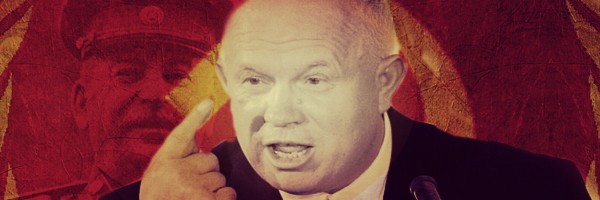
“Tumultuous, prolonged applause ending in ovation. All rise.” Khrushchev’s “Secret Report” and Poland
On the last day of the twentieth Congress of the Communist Party [Feb. 14–25, 1956] of the Soviet Union the doors were closed. Delegates were forbidden from taking notes. There was no stenographer and there was to be no discussion. It was then that Nikita Khrushchev, first secretary of the Communist Party, delivered his paper [...]
Sexuality, Sin, and Sacrifice – Deconstructing the Patriarchy. An interview with Dr. Mary Condren
Censorship is not limited to totalitarian States. It can be a subtle thing, when disconcerting ideas are not banned, but, through various means, marginalised. Dr. Mary Condren’s groundbreaking work The Serpent and the Goddess, a study on women, religion and power in Celtic Ireland, was never placed on an index of banned books, and yet [...]